Jobs report and CPI release headline latest economic data
Payrolls rose 29,000 and unemployment held at 4.2% in September, while August factory orders edged up 0.1% and construction spending gained 0.9%.
| Indicator | Period | Latest reading |
|---|---|---|
| Payroll employment (prelim.) | Sep 2026 | +29,000 |
| Unemployment rate | Sep 2026 | 4.2% |
| Average hourly earnings (prelim.) | Sep 2026 | +$0.05 |
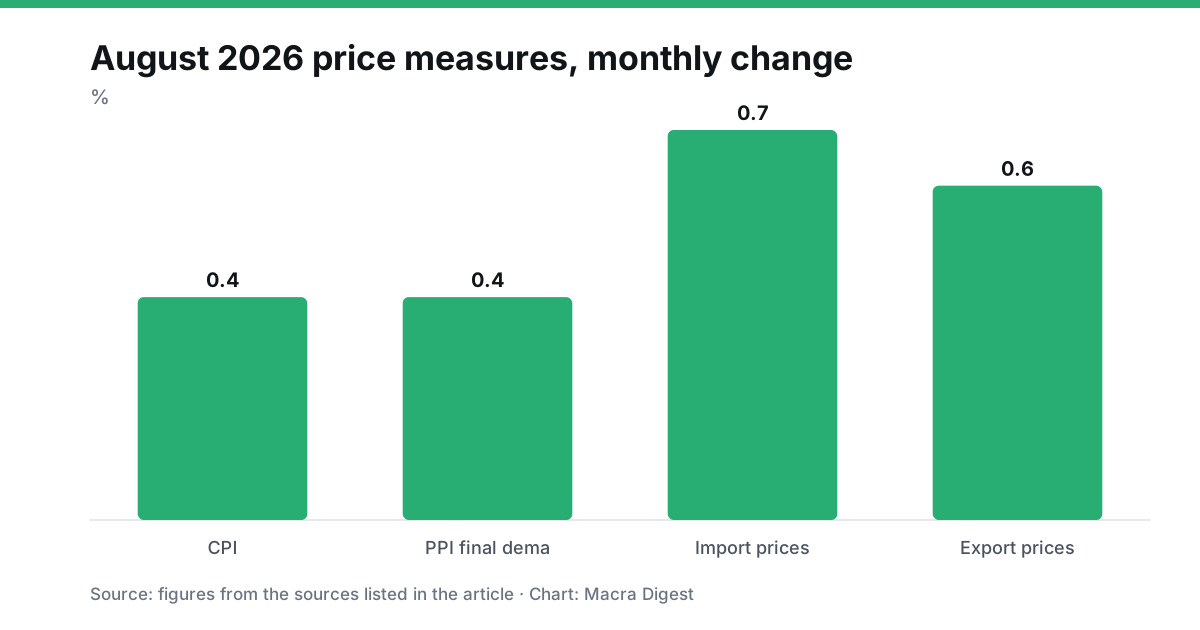
| Consumer Price Index | Aug 2026 | +0.4% |
| Producer Price Index, final demand (prelim.) | Aug 2026 | +0.4% |
| Import / export prices | Aug 2026 | +0.7% / +0.6% |
| Employment Cost Index | Q2 2026 | +0.9% |
| Productivity | Q2 2026 | +1.4% |
| Factory orders | Aug 2026 | +0.1% to $663.5 billion |
| Construction spending | Aug 2026 | +0.9% to $2,203.1 billion |
The latest economic data today comes from the final days of last week’s calendar. The September jobs report and fresh readings on prices, factory orders and construction all landed between Thursday and Friday. Here is what the sources show.
Key takeaways
- The September jobs report shows a preliminary payroll gain of 29,000 and an unemployment rate of 4.2%.
- The August CPI release and the producer price figure both read +0.4%.
- Factory orders rose for a second straight month, but only 0.1% in August.
- Construction spending rose 0.9% in August, though the gain is no larger than its stated margin of error.
Jobs report: small payroll gain, 4.2% unemployment
The Bureau of Labor Statistics’ latest-numbers page, updated Friday, lists preliminary September payroll employment of +29,000. The unemployment rate stands at 4.2%. Average hourly earnings are shown up $0.05, also preliminary.
The payroll and earnings figures are marked preliminary, so they are subject to revision in later releases. The sources give no consensus forecasts or prior-month comparisons, so this roundup does not judge the report against expectations. A payroll gain of this size is small in absolute terms. The next revisions will show whether it holds.
CPI release and other price gauges
The same BLS page shows consumer prices up 0.4% in August. Producer prices for final demand also rose 0.4% on a preliminary basis. Import prices rose 0.7% and export prices rose 0.6%, so price pressure showed up at several points in the chain that month.
The quarterly labor-cost data point the same way. The Employment Cost Index rose 0.9% in the second quarter. Productivity rose 1.4% in the same quarter. The sources do not say how these compare with earlier periods, so the readings are best treated as a snapshot.
Factory orders: second straight gain, but a slim one
The Census Bureau reports that new orders for manufactured goods rose $0.7 billion, or 0.1%, to $663.5 billion in August. That follows a revised 0.8% increase in July, so orders have now risen two months running. The pace slowed sharply from July to August.
For manufacturers and their suppliers, the second straight rise is a modest sign of demand holding up. The August gain is too small to show a change in direction on its own.
Construction spending: a gain within the margin of error
Total construction spending in August was $2,203.1 billion, according to Census. That is 0.9% above the revised July estimate of $2,184.5 billion. July itself was revised to a 0.1% decline.
Census puts the margin of error on the August change at plus or minus 1.0 percentage point. The 0.9% gain therefore falls inside the range, and the data cannot rule out a flat or slightly lower reading. Construction estimates are often revised, so later releases may change the picture.
What to watch next
The main question is how revisions treat the preliminary September payroll, earnings and producer-price figures. Further factory-order and construction-spending readings will show whether August’s modest gains continue. Check the economic calendar for the next scheduled releases from BLS and Census.
Prepared with AI assistance from public sources and reviewed under our editorial policy. Not investment advice.